The Benevolent and Protective Order of Elks was founded in 1867 in New York as a social club. Its mission broadened after the unexpected death of a member left his wife and children without financial support, inspiring the group to add charitable service to its fellowship. The organization grew rapidly, and by 1890, 173 lodges had been established nationwide. That same year, the Elks held their first national convention in Cleveland, Ohio. Detroit hosted the event just three years later, in 1893, although it passed largely unnoticed by the local press. By 1910, Michigan boasted 38 lodges and more than 16,500 members—membership then limited to white Christian men. The Elks’ return to Detroit that year would be an entirely different story.
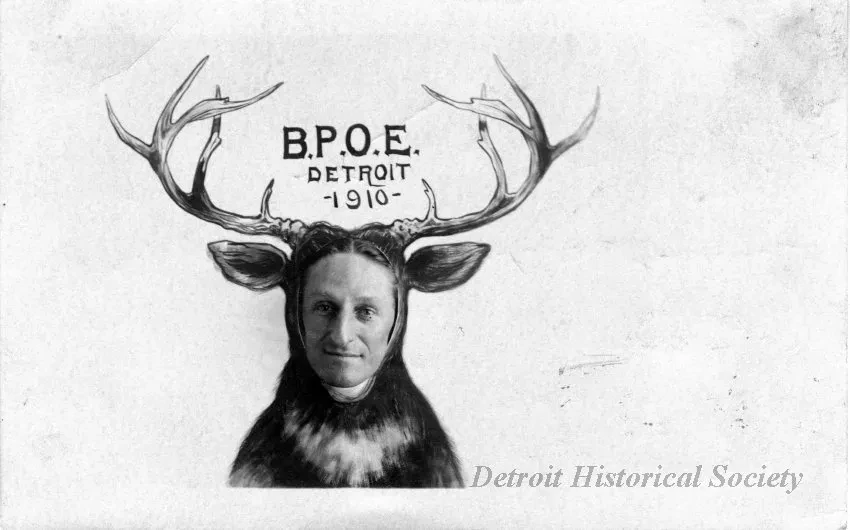
Postcard featuring a black and white photograph of a man's face superimposed on an elk body with antlers. Detroit Historical Society collection.
1910 Convention Fanfare
The national convention, officially titled the Elks Grand Lodge Convention, was scheduled for July 10–17, 1910. A glowing editorial published January 2, 1910, in the Detroit Free Press by real estate developer Henry Plass extolled the economic and social benefits the event would bring to the city. At the time, hosting the Elks National Convention was considered as prestigious as hosting a world’s fair. Articles and advertisements promoting the convention ran in newspapers around the country starting in January 1910. Detroit even had its own musical promotion: “Hang Your Hat in Detroit,” a song composed specifically to celebrate the convention and invite Elks from across the nation to visit the city.
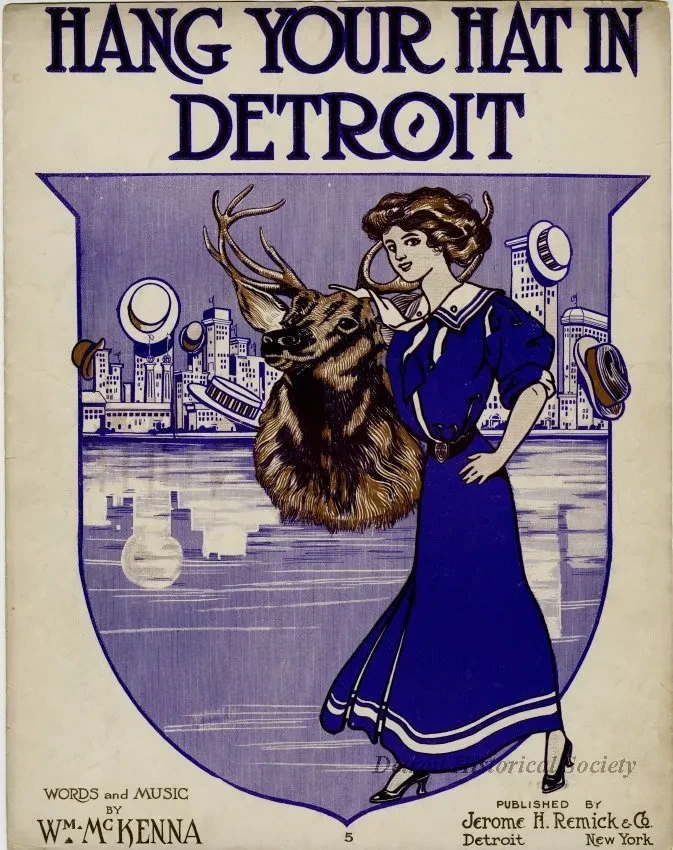
Sheet music for the song "Hang Your Hat in Detroit," written by William McKenna and published by Jerome H. Remick and Company. Detroit Historical Society collection.
The city prepared to welcome over 100,000 visitors, including more than 60,000 spouses and family members, and the event took over Detroit. Residents were encouraged to decorate their homes and businesses and wear purple and white—the convention’s official colors. Hotels raised their rates, anyone with a spare room advertised lodging, and special shopping days were planned specifically for women. Newspaper boys were recruited to serve as guides, and the Detroit Police Department brought in detectives from across the country to curb pickpockets and other criminals during the convention. 250 special telephone lines were installed throughout the city to handle the communications load. To handle an anticipated 45,000 pieces of luggage arriving with convention-goers and their families, a temporary baggage system was established to transport luggage between Michigan Central Station and hotels across the city. Enormous arches decorated with electric lights were constructed over Woodward Avenue.
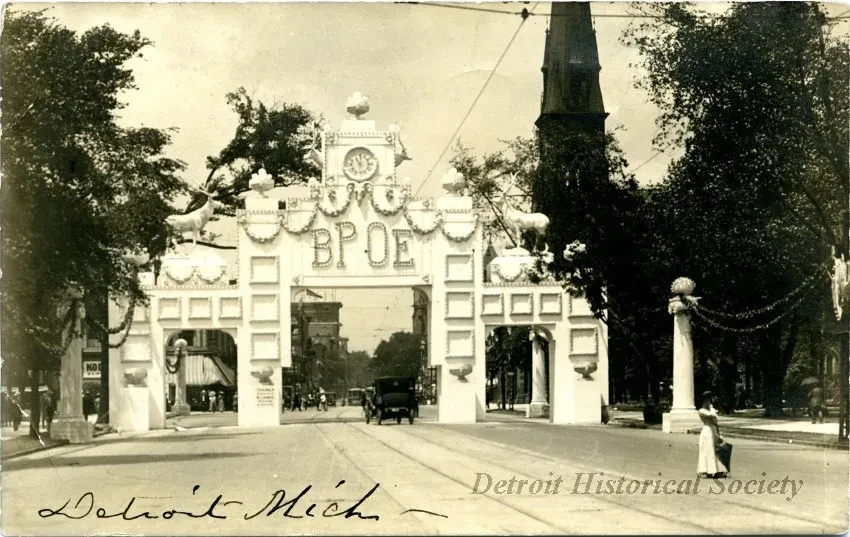
Black and white photographic postcard depicting a decorative arch for the Elks National Convention parade on Woodward Avenue in Grand Circus Park. Detroit Historical Society collection.
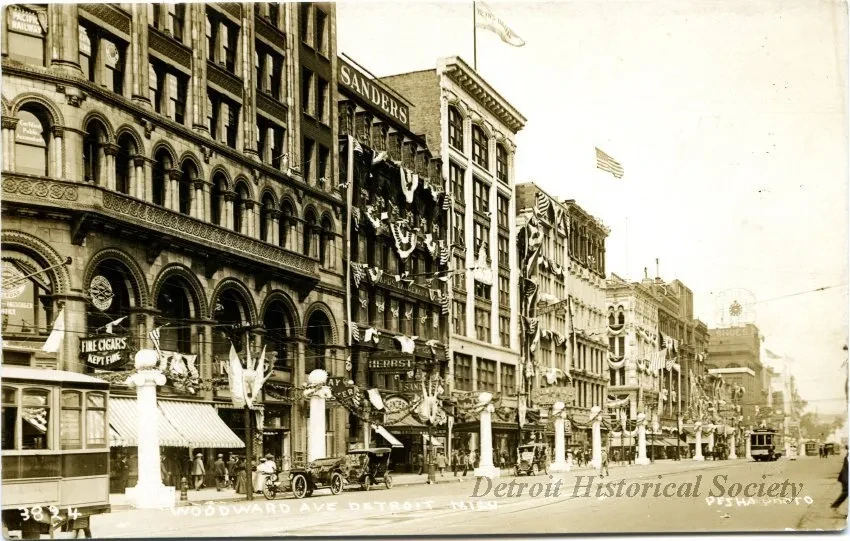
Black and white photographic postcard depicting Woodward Avenue decorated for the Elks National Convention parade. Detroit Historical Society collection.
In reality, newspapers estimated that only 40,000 people visited Detroit. The discrepancy may have been due to travel costs, limited accommodations, competing events, or the organizers’ over-enthusiasm in predicting attendance.
Entertainment abounded: Three major parades featuring elaborate floats were planned. The U.S. Secretary of the Navy sent the gunboat Wolverine, and the Department of Commerce and Labor dispatched lighthouse tenders to the Detroit River for the occasion. The Detroit Tigers schedule was rearranged to make sure they played a home game during the convention. Wright brothers’ aeroplanes soared in exhibition flights at the Michigan State Fairgrounds, local theaters mounted Elk-themed performances, and special shopping tours were organized for visiting women. There were contests of all sorts, and an extravagant fireworks display over Belle Isle. For one spectacular week, Detroit became the epicenter of fraternal pride, civic celebration, and orchestrated hospitality on a national scale.
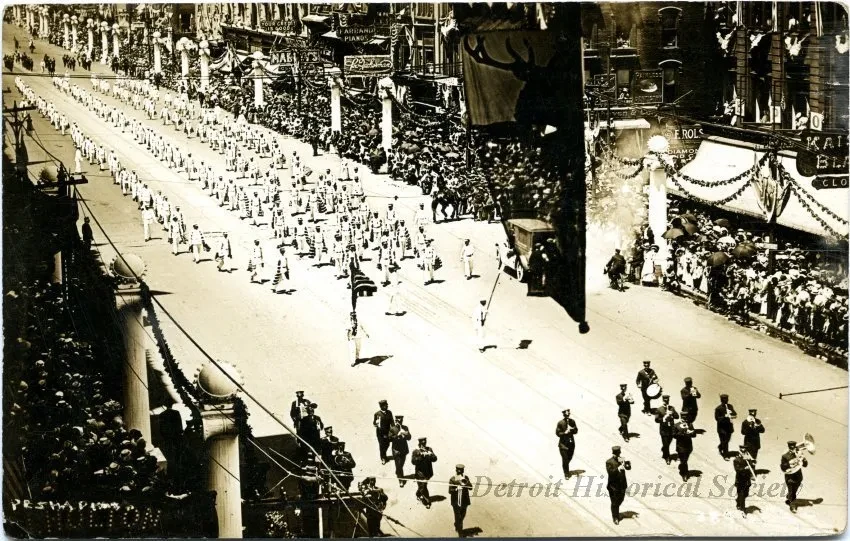
Black and white photographic postcard depicting the Elks National Convention parade on Woodward Avenue. Detroit Historical Society collection.
Explore More
See more photos and artifacts from the 1910 Elks Grand Lodge Convention in our digital collection!