Four-panel brochure promoting the Detroit International Exposition and Fair held from September 17th to the 27th of 1889. Detroit Historical Society collection.
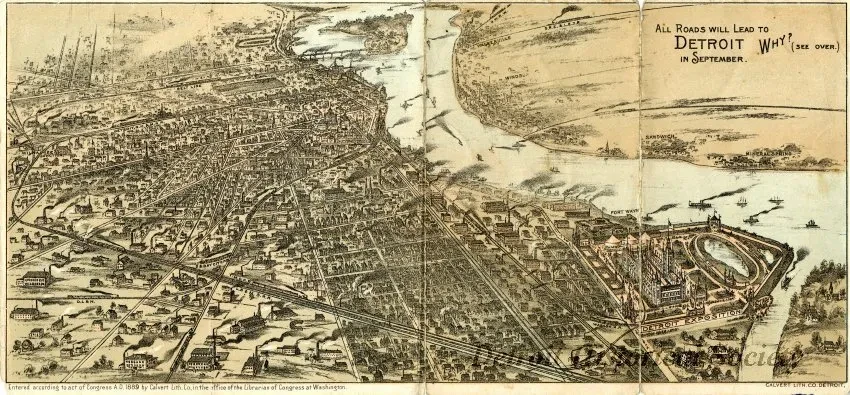
The grand Detroit International Exposition and Fair ran September 17 to 27, 1889, on 72 acres at the confluence of the Rouge and Detroit rivers in Delray. Promoters advertised more than $100,000 in cash prizes across dozens of competitive divisions and promised a "colossal" art display alongside races, industrial exhibits, horticultural presentations, and livestock competitions. Music throughout the grounds was provided by Signor C. A. Cappa's celebrated Seventh Regiment Military Band, while the event ultimately drew crowds in the hundreds of thousands, underscoring the scale of Detroit's ambition.
Wonders on the Fairgrounds
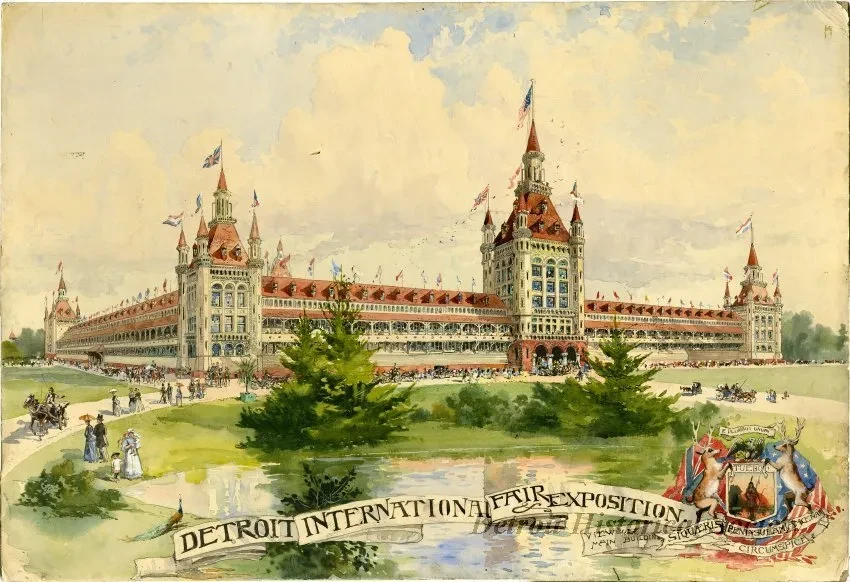
Watercolor painting on board depicting the main building erected for the Detroit International Exposition and Fair of 1889. Detroit Historical Society collection.
The architecture itself embodied that ambition. Designed by the young Bavarian architect Louis Kamper, who had arrived in Detroit only a year earlier, the main exhibit hall was widely hailed as the largest exposition building in the country. Encompassing roughly 200,000 square feet of exhibition space, it featured a soaring 200-foot observation tower that offered panoramic views of the Detroit River, the city, and Canada. Vast skylights and windows—covering nearly five acres of glass—filled the interior with natural light, creating a dramatic setting for exhibitions ranging from massive industrial machinery to agricultural displays.
A separate Art Building anchored the fair's fine arts program. Contemporary advertisements promoted a traveling American Prize Fund exhibition featuring 350 paintings by leading American artists, while the fair also mounted a formal First Fine Arts Exhibition with its own printed catalogue. Together, these exhibitions transformed the Art Building into one of the largest displays of contemporary American painting ever assembled in Detroit, reflecting the city's determination to establish itself as a serious cultural center Beyond the galleries, visitors experienced an extraordinary variety of attractions and competitions. Firemen's Tournament events, horse and river races, an apiary, and extensive livestock exhibitions featuring cattle, sheep, poultry, and pets celebrated agriculture and industry alike.
Machinery Hall showcased the latest scientific and technological innovations, while the Floral Palace, managed by the Michigan Horticultural Society, and an expansive Palm Garden created lush greenhouse environments filled with exotic plants. Visitors moved seamlessly between industrial demonstrations, gardens, musical performances, and art exhibitions, making the exposition an immersive celebration of Detroit's cultural, agricultural, and technological achievements. as well as an industrial powerhouse.
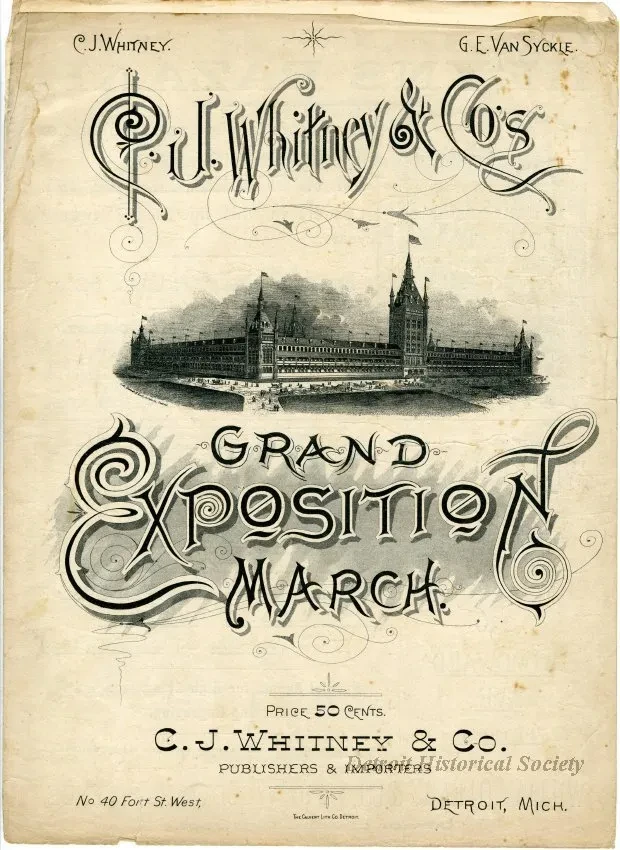
Sheet music for "C. J. Whitney & Co.'s Grand Exposition March", by G. E. Van Syckle, published by C. J. Whitney & Co. Detroit Historical Society collection.
The 1889 Detroit International Exposition & Fair proved both a financial and public success, and it was made into an annual event. However, attendance gradually declined and the exposition was discontinued after three more years. In 1895, Solvay Processing Company purchased the land and destroyed the building. The 1889 Exposition remains one of the most ambitious public exhibitions in Detroit's history—a bold statement of the city's confidence and aspirations on the eve of its emergence as one of America's great industrial centers.
Explore More
See more remarkable photos from the 1889 Fair and Exposition in the Detroit Public Library's Burton Collection, including views inside of exhibit halls, events on the fairgrounds, portraits of attendees, and more.